- by foxnews
- 01 Apr 2026
Billionaires boomed in Biden era as Fed became 'engine of income inequality' powered by COVID policies: expert
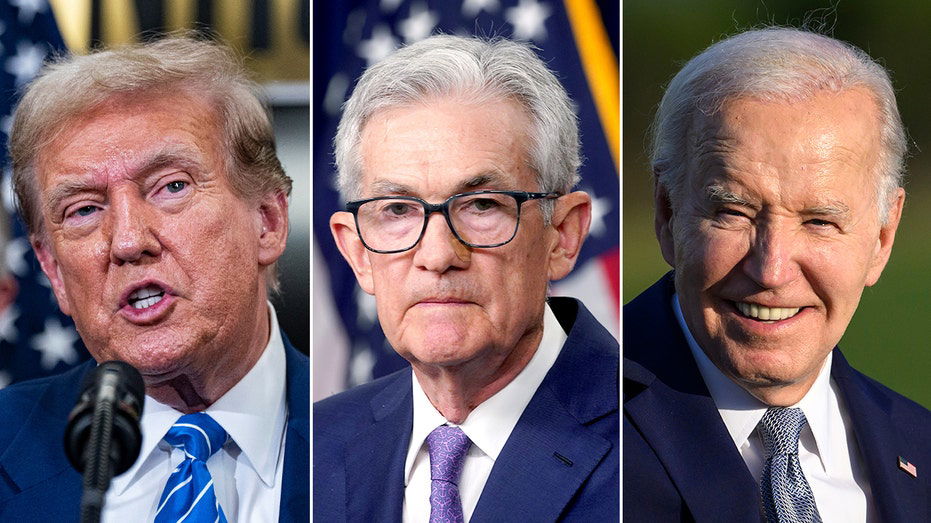
Billionaires saw their wealth increase across the last four years due to policies put forth by the Federal Reserve, leading to financial boosts for the wealthy, economists say.
1.5 k views
"If you look at the amount of federal regulation, the amount of federal taxes, if anything… the economy has gotten less friendly toward big business, and toward rich people," economist Peter St. Onge told Fox News Digital in a May phone interview. "What's actually been happening is that the Fed has been driving income inequality. And, I think for a long time, Republicans were sort of in denial - not just Republicans, but sort of free market types were in denial - and they didn't want to talk about income equality."
"I think they should absolutely talk about it, because what's causing it is not free markets," he said. "It's something that I think everybody should oppose, which is government manipulation of the monetary system."
JPMorgan Chase's private bank estimated that the number of billionaires in the U.S. increased from 1,400 in 2021 to nearly 2,000 as of 2024, the Wall Street Journal reported in April.
The Federal Reserve is America's central bank, which sets monetary policies and oversees banks. It acts independently, meaning it does not require approval from the president or Congress when enacting policies.
St. Onge explained to Fox News Digital that "debt is a rich man's game" and that billionaires have benefited financially since the pandemic as the Fed worked to "manipulate interest rates" down below market value, which subsidized loans.
"During COVID, you could get a mortgage for, you know, three, three and a half percent, when inflation was running higher than that," he explained. "You were literally being paid to borrow money, which is not a free market outcome.… So it makes loans cheap and the rich overwhelmingly borrow money."
The average debt for the top 5% of Americans sits at about $600,000, he said, while the average debt for the vast majority of Americans is roughly $74,000.
"That's about a nine times difference," he said of the data. "So if you make loans too cheap, you are giving nine times more money to rich people.… If you make loans cheap, you're functionally giving $9 to rich people for every $1 to give everybody else."
Assets are even more skewed, he explained, with the top 5% of Americans holding $7.8 million in assets compared to the average American's $62,000 - notching 130 times the difference between the two demographics, he said.
"The value of a stock or even a house are based on the future stream of income, and those are all discounted by the interest rate," he said. "And so pretty close to mechanically, if you cut interest rates in half - long-term interest rates - you are doubling the value of stocks."
"The reason is because, since the 1970s, the Fed has very aggressively held rates low, and so this has caused all those assets to go up. So stocks have gone up, housing has gone up. And again, those are rich men's games. Overwhelmingly, people who own stocks are rich. Housing is even more skewed."
"So if you've got a nine times difference on loans between the bottom 50% and the top 5%, and then you've got 130 times on assets, then the Fed manipulating rates down - they're not doing it to make rich people rich, hopefully - but that's sort of the consequence of doing that," he said. "Holding long-term interest rates low is to shower money on rich people and to shower it in proportion to which they're rich, right? So the most extreme version of that is going to be billionaires."
Economist Steve Hanke discussed how the Federal Reserve has fanned the flame of income inequality through its policies at a conference earlier in 2025 at the Mises Institute, an economics-focused think tank based out of Alabama.
"Thanks to the Fed's helicopter money drops beginning with COVID, the annual growth rate of the US broad money supply peaked at 18.1% per year in May 2021," he added. "Lo and behold, the transmission mechanism followed - the S&P 500 reached a local maximum in December 2021 (6 months later), and inflation peaked at 9.1% per year in July 2022 (14 months later)."
The result, he said, was skyrocketing wealth inequality to the tune of billionaires increasing their share of the GDP by 7.6 percentage points in just four years.
St. Onge said the Fed's policies have been political in nature, while remarking he would welcome "naive" Democrats who bang the proverbial campaign drum of income inequality to jump onto the "end the Fed bandwagon."
"They have a naive argument where they look at rich people and they say, 'Hey, this is so terrible. We live in this dog-eat-dog jungle of an economy,'" St. Onge said of Democrats who campaign on income inequality. "And that is inaccurate," he added, citing Federal Reserve policies that have amplified income inequality.
"Wall Street barons crashed the economy and American builders went out of business," Vance said from Milwaukee in summer 2024. "As tradesmen scrambled for jobs, houses stopped being built. The lack of good jobs, of course, led to stagnant wages. And then the Democrats flooded this country with millions of illegal aliens. So citizens had to compete - with people who shouldn't even be here - for precious housing. Joe Biden's inflation crisis, my friends, is really an affordability crisis."
The Federal Reserve Board declined comment when approached by Fox Digital regarding St. Onge's and Hanke's remarks.
you may also like

- by foxnews
- 01 Apr 2026
States' top cops gang up on Letitia James in crusade with potential nationwide consequences



travel
- by foxnews
- descember 09, 2016
Sharks in Bahamas found to have cocaine and other drugs in their systems, study says
A new study found cocaine, caffeine and painkillers in 28 Bahamas sharks, with researchers saying tourists may be the likely source of the contamination.
read more