- by foxnews
- 11 Apr 2026
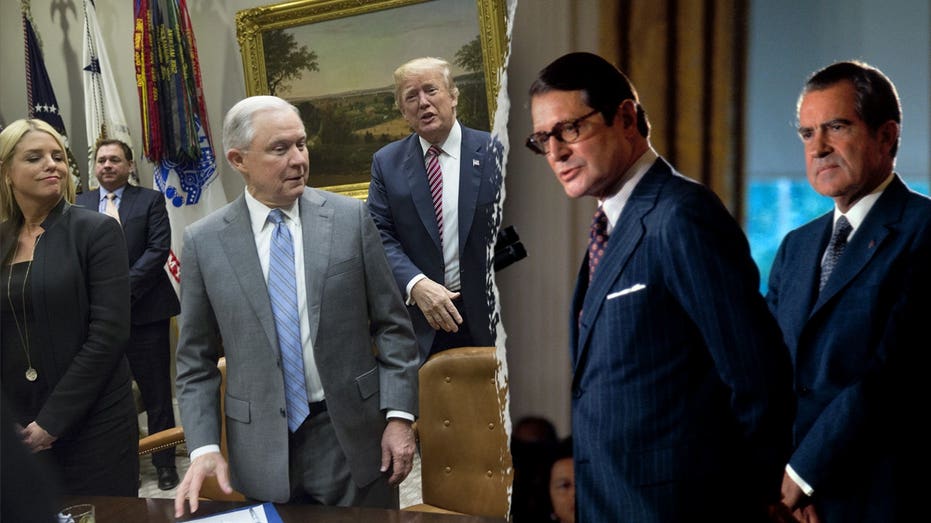
Top cops out: The attorney general firings and forced exits that made history
Pam Bondi's exit is the latest in a long history of attorney general firings and resignations that shook Washington, from Nixon to Trump and beyond.
1.3 k views
Former President George Washington appointed Founding Father and former Virginia Gov. Edmund Randolph the nation's first attorney general in 1789, and in the years since, there have been dozens of successors, some lost to history and others more memorable.
Eliot Richardson, the secretary of defense at the time of the Watergate burglary, was named to succeed Attorney General Richard Kleindienst, who resigned amid the scandal after reportedly being pressured by a member of the Watergate "plumbers" to assuage the situation.
"Plumbers" was the moniker for the group accused in the burglary at the DNC headquarters, then located at the Watergate Hotel in Foggy Bottom, D.C. They were organized by CIA officer E. Howard Hunt and FBI agent-turned-future conservative talk radio star G. Gordon Liddy. The name purportedly came from the dual meaning of "leaks" - political versus pipes.
Kleindienst reportedly told the G-man to get lost, and the federal investigation ensued as normal.
"Mr. Kleindienst asked to be relieved as Attorney General because he felt that he could not appropriately continue as head of the Justice Department now that it appears its investigation of the Watergate and related cases may implicate individuals with whom he has had a close personal and professional association," Nixon said in a public letter that day.
Richardson's tenure began thereafter and ended with one of the most significant executive branch departures in history: the "Saturday Night Massacre."
On October 20, 1973, Nixon ordered Richardson to fire Watergate special prosecutor Archibald Cox shortly after Cox subpoenaed the Oval Office recordings. Richardson, who appointed Cox and reportedly pledged not to fire him without cause, refused and resigned.
Nixon then asked Richardson's deputy, William Ruckelshaus, to fire Cox, and he also resigned instead of carrying out the order.
Nixon then ordered Ruckelshaus' deputy, Solicitor General Robert Bork, who is better known for his unsuccessful nomination to the Supreme Court by President Ronald Reagan, to fire Cox. Bork did so and reportedly considered resigning but stayed on at the urging of his predecessors to ensure stability at the DOJ.
That November, an LBJ-appointed federal judge found that Cox's firing had been unlawful.
Nixon himself ultimately resigned almost one year later on August 9, 1974.
Gonzales ultimately resigned the top cop post in 2007 amid mounting bipartisan criticism of the DOJ's firing of several U.S. attorneys and allegations that he was not forthright during congressional inquiries about whether politics played a role in the firings.
Bush lamented his friend's resignation, saying "it is sad that we live in a time when a talented and honorable person like Alberto Gonzales is impeded from doing important work because his good name was dragged through the mud for political reasons."
Gonzales faced mounting pressure and criticism amid the firings and regarding comments defending enhanced interrogation techniques against suspected terrorists.
He stated "I do not recall" or similar framings of the statement dozens of times during a contentious Senate hearing where he battled Republicans like Pennsylvania's Arlen Specter and Democrats including California's Dianne Feinstein.
Sen. Charles Schumer, D-N.Y., later confronted Gonzales over his responses.
In his testimony, Gonzales said U.S. Attorneys indeed serve at the pleasure of the president, and that the Justice Department makes "decisions based on the evidence, not whether the target is a Republican or a Democrat."
Ultimately, Gonzales announced on August 27, 2007, that he would be stepping down on September 17.
"Yesterday I met with President Bush and informed him of my decision to conclude my government service as attorney general… let me say that it's been one of my greatest privileges to lead the Department of Justice," Gonzales said in his resignation announcement.
"I have great admiration and respect for the men and women who work here. I have made a point as attorney general to personally meet as many of them as possible, and today I want to again thank them for their service to our nation."
Former Alabama Sen. Jeff Sessions was the first in the upper chamber to endorse then-developer Donald Trump in his 2016 presidential bid.
The immigration enforcement hardliner and Trump loyalist, however, saw his relationship with the new president fray early in their term.
Sessions' tenure ended the day after Republicans lost the House in the 2018 midterm elections, but left the Alabamian with a successful professional record in reversing Obama-era policies and cracking down on sanctuary city policies.
Barr, who previously served under President George H.W. Bush, appeared to irritate Trump when he told The Associated Press he had not seen "fraud on a scale that could have effected a different outcome in the election."
In announcing the departure, Trump tweeted that he had a "nice meeting" with Barr and that his relationship "has been a very good one; he has done an outstanding job."
Barr also touted Trump's first-term record amid what he called a "partisan onslaught" and "relentless, implacable resistance."
In comments to NBC News in 2022 ahead of the release of his book "One Damn Thing After Another," Barr said he told Trump at the White House that he understood the president was frustrated with him, and that he was willing to submit his resignation.
"The absurd lengths to which he took his stolen election claim led to the rioting on Capitol Hill," Barr said, while adding that Trump's actions still wouldn't reach the legal level of "incitement" as claimed by Democrats.
In his resignation letter, Barr applauded Trump's ability to "weather" the Russia investigation and Democrats' attempts to "cripple if not oust [the] administration," and said the president restored the U.S. military and curbed illegal immigration.
The first attorney general of the modern era to be ousted was Harry Daugherty, a member of President Warren Harding's administration.
Daugherty's fall began amid the Teapot Dome Scandal - the most infamous incident prior to Watergate - which led to the imprisonment of Interior Secretary Albert Fall.
Fall was implicated in low- or no-bid oil leases at Teapot Dome, Wyoming, in 1923, and jailed for accepting bribes from energy companies.
Daugherty was later investigated for allegedly failing to prosecute people involved in Teapot Dome, and was allegedly implicated in a handful of other scandals, including being charged with conspiracy amid the sale of illegal liquor permits during prohibition.
He was also accused of influence peddling and members of the "Ohio Gang" were accused of selling government appointments.
The sibling's bank recorded "heavy withdrawals" during that time, which caught the attention of regulators in Columbus.
Harry Daugherty ultimately met his ouster after Harding died in office in August 1923.
New President Calvin Coolidge booted him from the DOJ over loss of public trust and refusal to turn over departmental records regarding alleged corruption.
Daugherty was never convicted.
you may also like
travel
- by foxnews
- descember 09, 2016
Cold War bunker 'waiting for Armageddon' found beneath medieval castle in 'perfect location'
Experts uncovered a lost Cold War nuclear bunker on the grounds of Scarborough Castle, a medieval fortress in North Yorkshire, England. The hideout had been presumed lost.
read more