- by foxnews
- 07 Apr 2026
Perseverance rover spots mysterious 'visitor from outer space' rock on Mars surface after 4 years
NASA's Perseverance rover discovers shiny metallic rock on Mars that could be a meteorite from an ancient asteroid, containing high levels of iron and nickel.
- by foxnews
- 21 Nov 2025
- in technology
1.2 k views
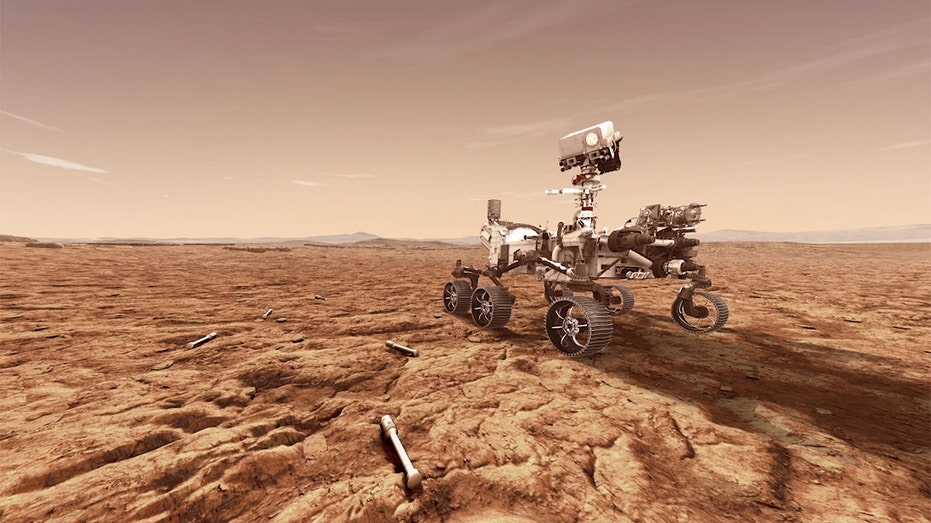
According to a new blog post on the rover's mission page, the rock - nicknamed "Phippsaksla" - stood out from the flat, broken terrain around it, prompting NASA scientists to take a closer look.
Tests revealed high levels of iron and nickel, the same elements found in meteorites that have crashed onto both Mars and Earth.
While this isn't the first time a rover has spotted a metallic rock on Mars, it could be the first for Perseverance. Earlier missions - including Curiosity, Opportunity and Spirit - discovered iron-nickel meteorites scattered across the Martian surface, making it all the more surprising that Perseverance hadn't seen one until now, NASA said.
Now, just beyond the crater's rim, the rover may have finally found one - a metallic rock perched on ancient impact-formed bedrock. If confirmed, the discovery would place Perseverance alongside the other Mars rovers that have examined fragments of cosmic visitors to the red planet.
To learn more about the rock, the team aimed Perseverance's SuperCam - an instrument that fires a laser to analyze a target's chemical makeup - at Phippsaksla. The readings showed unusually high levels of iron and nickel, a combination NASA said strongly suggests a meteorite origin.
Mounted atop the rover's mast, SuperCam uses its laser to vaporize tiny bits of material, so sensors can detect the elements inside from several meters away.
The finding is significant, NASA noted, because iron and nickel are typically found together only in meteorites formed deep within ancient asteroids - not in native Martian rocks.
Because Phippsaksla sits atop impact-formed bedrock outside Jezero crater, NASA scientists said its location could offer clues about how the rock formed and how it ended up there.
For now, the agency said its team is continuing to study Phippsaksla's unusual makeup to confirm whether it truly came from beyond Mars.
If proven to be a meteorite, the find would mark a long-awaited milestone for Perseverance - and another reminder that even on a planet 140 million miles away, there are still surprises waiting in the dust.
Built at NASA's Jet Propulsion Laboratory in Pasadena, California, the $2.7 billion rover is about 10 feet long, 9 feet wide and 7 feet tall - roughly 278 pounds heavier than its predecessor, Curiosity.
Powered by a plutonium generator, Perseverance carries seven scientific instruments, a seven-foot robotic arm and a rock drill that allows it to collect samples that could one day return to Earth.
you may also like


- by foxnews
- 07 Apr 2026
Amazon job text scam warning signs

- by foxnews
- 06 Apr 2026
Humanoid robot shows speed and real skill



travel
- by foxnews
- descember 09, 2016
Construction crew unearths surprising 300-year-old cannon while digging in historic city
In only the third such discovery in 30 years, according to archaeologists, construction workers in Kingston upon Hull unearthed a rare 300-year-old cast-iron cannon.
read more