- by foxnews
- 01 Apr 2026
Archaeologists uncover massive stone ruins from ancient city that once rivaled Rome
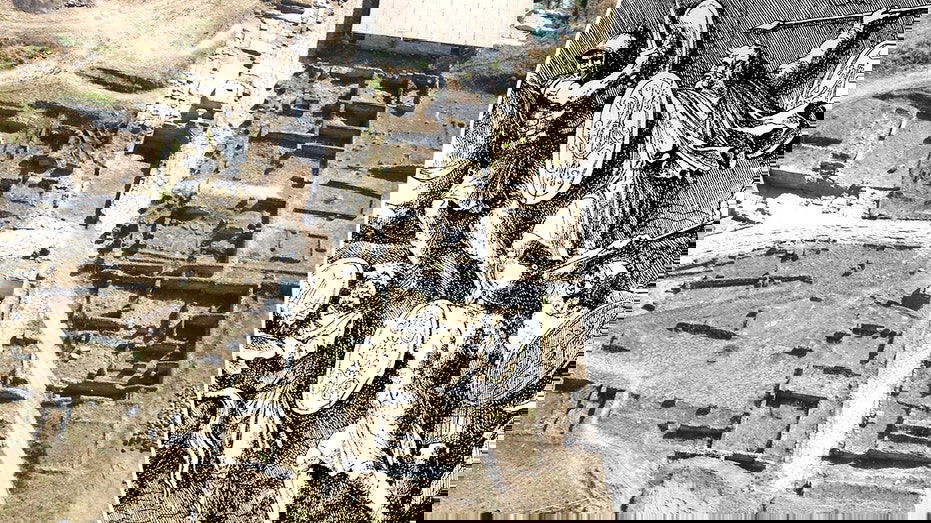
Archaeologists recently discovered a massive 2,000-year-old stone basin in ancient Gabii, Italy, revealing early Roman public architecture from Rome's powerful rival city.
1.1 k views
The discovery was found in the ancient ruins of Gabii, about 11 miles east of Rome. University of Missouri archaeologists uncovered the remains, according to an Oct. 16 university press release.
Marcello Mogetta, chair of the Department of Classics, Archaeology and Religion, estimated the basin was built around 250 B.C.
Mogetta told Fox News Digital that Gabii and Rome both "traced their descent from common ancestors."
"This underscores the close cultural ties, but the actual relationship was more complicated than this."
The two cities had a longstanding rivalry, driven by aristocratic clans and warlords. Mogetta said this likely played out in the form of small-scale raiding parties.
"The decisive victory of the Romans happened at the battle of Lake Regillus, located on the border of the territory of Gabii."
The area was occupied for 2,000 years before declining in the first century B.C. Former houses were demolished and repurposed into quarries, graveyards and workshops.
"The lack of a strong municipal elite meant that Gabii relied primarily on investments from the emperors, which faded over time," said Mogetta. "Initially, the geographical proximity to Rome may have been an advantage, making Gabii uniquely relevant on the map of central Italian city states."
He added, "In the long term, however, the growth of Rome as a metropolis and superpower on the international stage worked against Gabii."
The territory outside Gabii turned into marshland eventually, Mogetta said, which made it uninhabitable.
"There is evidence that Gabine elite families moved to Rome early on. … It made more sense for other middle-class Gabine inhabitants that didn't have ancestral ties to Gabii to leave for better opportunities in the burgeoning imperial capital," he said.
Mogetta said that field work in 2026 and 2027 will reveal more of the ruins. The expert told Fox News Digital that the basin was built at a "critical moment" in the 3rd century B.C., when Gabii's citizens and planners had the means and motivations to create an urban center.
At the time, Rome had become more successful in its conquests and was generating new wealth and ideas that spread to nearby communities like Gabii.
The result was a "comprehensive public building project that transformed the natural geomorphology of the landscape with a blend of local traditions and experimentation with Hellenistic culture," he said.
"The monumental pool we just discovered seems to have determined the spatial and monumental focus of a much larger ensemble that we do not yet see in its entirety," Mogetta said.
you may also like

- by foxnews
- 01 Apr 2026
First of its kind wagon evidence uncovered in massive Iron Age treasure trove

- by foxnews
- 01 Apr 2026
Traveler hands out vodka shots in massive TSA line amid US airport lines and delays



travel
- by foxnews
- descember 09, 2016
Sharks in Bahamas found to have cocaine and other drugs in their systems, study says
A new study found cocaine, caffeine and painkillers in 28 Bahamas sharks, with researchers saying tourists may be the likely source of the contamination.
read more