- by foxnews
- 27 May 2026
Archaeologists unearth Viking-era 'execution pit' near university town, exposing brutal ancient violence
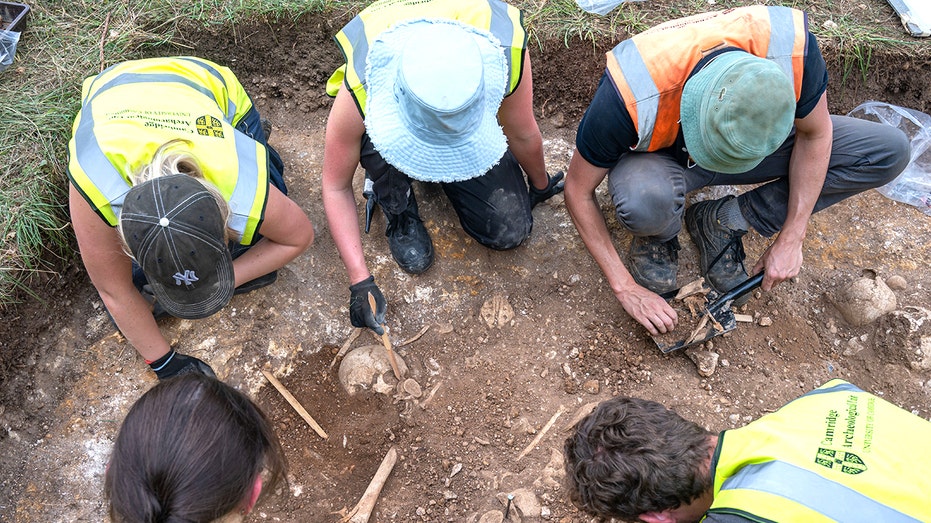
Cambridge students unearthed a likely 1,200-year-old "execution pit" containing the remains of 10 men, including stacked skulls and partial skeletons. Experts are studying the find.
1.4 k views
The burial dates back to the 9th century A.D., around the time Vikings conquered the area.
The pit "may date from a time when the area was a 'frontier zone' in the conflict between the Saxon-run kingdom of Mercia and the kingdom of East Anglia," the release noted.
The remains of around 10 young men were found, raising questions about whether the deaths were related to frontier conflict or judicial killings.
"Unusually, the mass grave held a mix of complete and dismembered remains, including a cluster of skulls without clear accompanying bodies and a 'stack of legs' as well as four complete skeletons, some in positions suggesting they were tied up," the release said.
Two main pieces of evidence suggest the site was an execution pit, said Oscar Aldred, an archaeologist at the Cambridge Archaeological Unit.
First, there is the location.
"Execution sites from this period are typically on the edge of a territory but also in prominent locations in the landscape."
The second piece of evidence, the archaeologist added, is the proof of beheading.
At least one skeleton showed "clear signs of having been decapitated," specifically incisions and chop marks on the left side of the lower jawbone.
"We don't yet have this information [at] hand because we haven't fully assessed all the individuals from the burial pit."
"[It's] very interesting," he noted. "The [deceased] individuals were deposited in the state of decomposition and, therefore, were not able to hold together, so to speak.
"The bone grouping within the burial pit is something we need to work harder on to understand further."
Though there's no proof yet of a battle in Wandlebury, the locale was recorded as a meeting place for "hundreds," or Anglo-Saxon territorial units.
"It is the kind of place where you might expect judicial assemblies to take place, where people would have met and made important decisions such as execution orders," Aldred said of the area.
"So, in the context of an execution, the setting fits, so to speak."
Researchers are now conducting DNA, isotope and radiocarbon testing to determine who the men were and what year they died.
Aldred added that further analysis will determine why the remains were arranged in this way.
"We're working with colleagues at the University of Cambridge to take these questions forward," he said.
"But, for now, we are raising the questions rather than definitively answering them."
you may also like


- by foxnews
- 27 May 2026
Tourist hovercraft capsizes without warning, leaving passengers fighting to survive
- by foxnews
- 27 May 2026
Woman stunned to unearth 3-carat diamond at state park after heartbreaking year



travel
- by foxnews
- descember 09, 2016
Extreme depth made fatal cave dive perilous at luxury honeymoon destination
Authorities describe the recovery of five Italian divers killed in a deep Maldives underwater cave as extremely difficult due to the depth and the currents.
read more